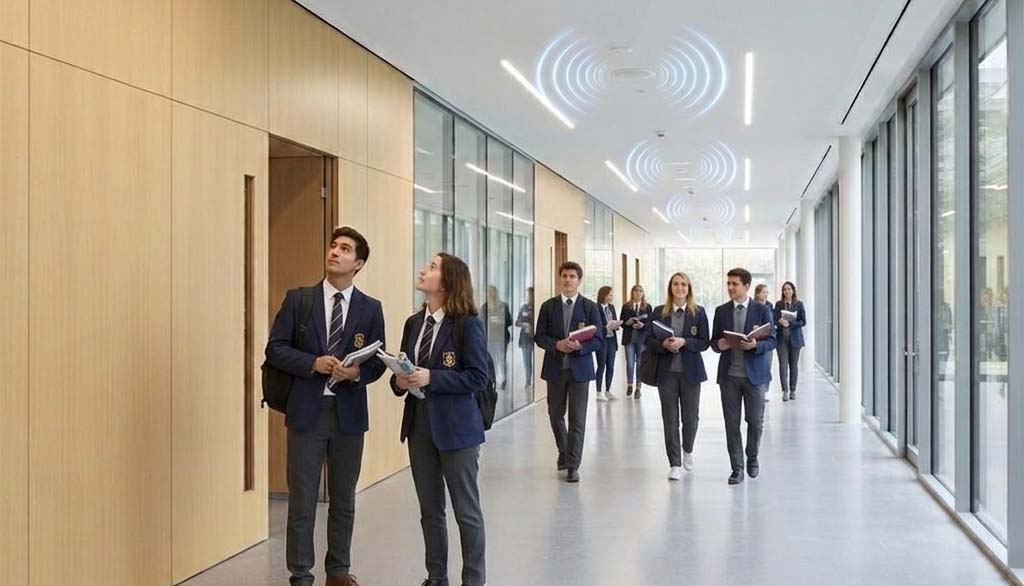
When it comes to emergency communication, the goal has always been simple: make sure every single person on site gets the message, understands it, and knows what to do.
Audio announcements and mobile alerts are both central to a well-designed emergency response, and we cover each in detail on their respective product pages. But there’s a third channel that’s consistently underestimated, despite being physically present in almost every UK workplace, school, hospital, and public building: screens. This article makes the case for why visual alerts belong alongside audio and mobile as an equal part of your emergency communication plan – and what the whole system becomes when all three are working together.
Screens reinforce what audio communicates
A voice announcement carries immediate authority. When an alert sounds and a clear instruction follows, people respond. Screens don’t change that – they amplify it. The same message that’s being heard across the site is simultaneously visible on every connected screen, reinforcing it through a second sense at exactly the same moment.
For most people in most situations, that reinforcement simply adds confidence and clarity. But for someone in a high noise environment, someone wearing headphones, a visitor unfamiliar with the building, or a person with a hearing impairment, the visual alert isn’t just reinforcement – it’s the channel that ensures the message lands. Audio and screens together mean that no single set of circumstances can prevent someone from receiving a critical instruction.
Screens extend the reach of your mobile alerts
Mobile alerts are powerful precisely because they follow people – off-site, between buildings, away from fixed infrastructure. That personal, direct connection to an individual is something screens can’t replicate, and it’s what makes mobile such an important part of the picture.
What screens bring is something different: presence in a physical space. A screen alert reaches everyone in a room, corridor, or reception area simultaneously – including visitors, contractors, and anyone else who isn’t registered in your system and wouldn’t receive a push notification. Rather than competing with mobile, screens extend the total reach of your communication. Between them, the two channels cover both the people and the places.
Visual communication carries detail that travels well under pressure
One of the practical strengths of screens in an emergency is their ability to hold information visibly and persistently. A voice announcement is heard once and then it’s gone – people act on what they remember. A screen alert stays visible, displaying the instruction clearly for as long as it’s needed, giving people something to refer back to as they respond.
This becomes especially valuable when different parts of a site need different instructions at the same time. Zoned messaging allows each area to display exactly what’s relevant to them- one zone directed to a specific exit, another told to stay put – without creating confusion across the wider building. It’s a level of targeted, persistent clarity that audio and mobile complement beautifully but can’t fully replicate on their own.
Flexible display formats help here too – full screen takeover for the highest priority alerts, ticker bars for lower urgency updates – ensuring the visual weight of a message matches the situation. Acknowledgement features add a further layer, letting administrators see in real time which screens and users have received a message. That visibility and audit trail is increasingly relevant as Martyn’s Law moves toward enforcement, with organisations required to demonstrate that their communication procedures are genuinely effective.
Daily use builds the habits that matter in an emergency
Perhaps the most underappreciated benefit of integrating screens into your communication setup is what happens on an ordinary Tuesday. Organisations that use their screen network for day-to-day communication, build something that pays dividends in a crisis: a team that’s already in the habit of looking at those screens.
The same is true of audio and mobile. Systems that are used regularly, for everyday as well as emergency communication, become instinctive. Staff don’t have to think about what a notification means or where to look – they already know. That familiarity, built up over time through routine use, is one of the most practical things an organisation can invest in.
The complete picture
Audio reaches people through sound. Mobile reaches people through their devices. Screens reach people through the spaces they occupy. Each channel has a distinct strength, and each makes the others more effective – reinforcing the same message through different means, covering different environments, and reaching different people.
Together, they create a communication system with no meaningful gaps. That’s the value screens bring – not as a replacement for anything, but as a channel that completes the picture.