This week, the UK is in the middle of one of the most significant heatwaves on record. The Met Office has issued a Red Extreme Heat Warning – the highest alert level – for parts of England and Wales, with temperatures forecast to reach 38°C and humidity levels described as more oppressive than the record-breaking July 2022 event. For the first time this summer, consecutive nights are expected to stay above 20°C, meaning the usual overnight recovery from daytime heat simply won’t happen.
For organisations responsible for the wellbeing of staff, students, and the public, that combination of extreme heat and sustained humidity isn’t just uncomfortable – it’s a genuine operational challenge. And while practical measures like hydration, ventilation, and adjusted schedules rightly get most of the attention, there’s an aspect of heatwave management that’s often underestimated: communication.
The heatwave isn’t just a facilities problem
When temperatures climb, the natural instinct is to focus on the physical environment – opening windows, closing blinds, moving activities indoors, checking that cooling systems are working. All of that is important. But a heatwave also creates a constant stream of information that needs to reach people quickly, clearly, and repeatedly throughout the day.
Hydration reminders, updates on which areas of the building are cooler, guidance on adjusted break times or schedules, notifications when outdoor activities are cancelled or relocated, reminders about sun safety. In a school, hospital, a workplace, or a public venue, the volume of communication required during a heatwave is significantly higher than on an ordinary day.
Heat related illness can develop quickly, particularly in people who are already active or who are in poorly ventilated spaces. Prompt, clear communication about what to do, where to go, and what to watch out for is part of the duty of care every organisation holds towards the people on their site.
Schools face a particular set of challenges
For schools still open during this week’s heat, the operational complexity is significant. Uniform policies, PE schedules, outdoor play, and the sheer number of people moving around a site throughout the day all create communication demands that can’t be handled through a single announcement at the start of the morning.
A headteacher who needs to remind staff about relaxed uniform expectations, update parents about changes to the afternoon timetable, inform year groups about relocated lunch arrangements, and need to push a reminder to teaching staff about hydration – all before midday – needs a communication system that can carry different messages to different audiences quickly and without disruption.
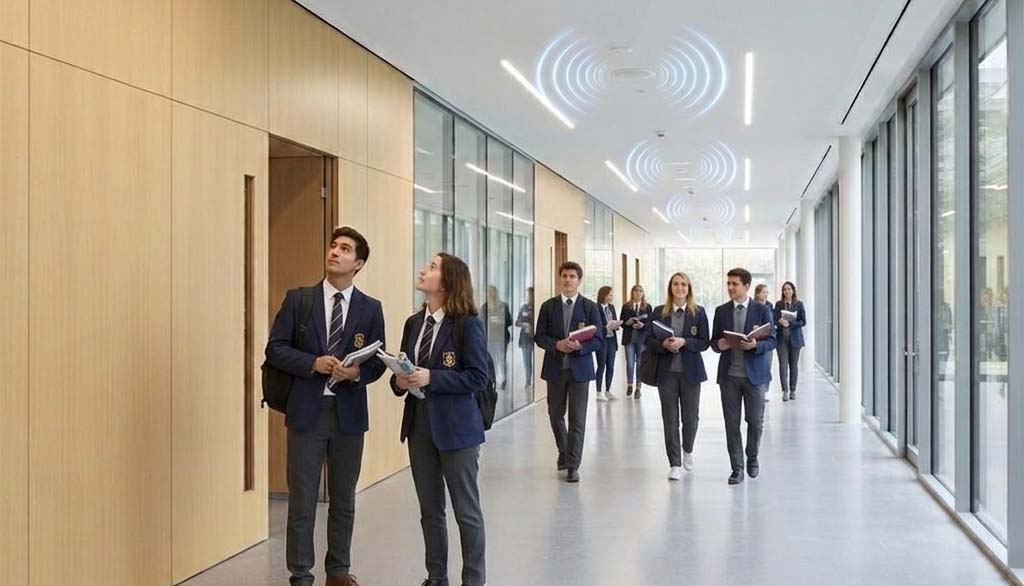
The ability to push targeted announcements to a specific year group, a particular building, or the whole school simultaneously – through audio, screens, and mobile alerts – means the right people get the right information at the right moment. That’s not just operationally efficient. In a week like this one, it’s genuinely important for welfare.
Communication that keeps pace with a changing situation
What makes a heatwave different from most operational challenges is that the situation keeps evolving throughout the day. A room that was manageable at 9am may be unusable at 11am. An outdoor activity that seemed fine at registration may need cancelling an hour later. Guidance from the UK Health Security Agency may update. Staff may need reminding again – and again – because heat affects concentration and retention just as much as comfort.
That ongoing, dynamic nature of heatwave management is where communication infrastructure really earns its place. A single morning briefing isn’t enough. What’s needed is the ability to push updated information to the right people at the right moment, repeatedly and without friction – whether that’s a site wide audio announcement, a visual reminder on screens in corridors and common areas, or a direct mobile alert to staff on the move.
Each channel plays a role. Audio cuts through immediately and reaches everyone in a space without requiring any action on their part. Screens reinforce messages visually and persistently – useful for reminders that need to stay visible, like hydration guidance or updated room allocations. Mobile keeps people informed even when they’re away from fixed infrastructure, ensuring that the message reaches the person rather than just the place.
Together, they mean that as the day changes, your communication keeps pace with it.
That’s what effective heatwave management looks like in practice. Not just the right physical measures, but the right information reaching the right people at every point throughout the day.