The Home Office has introduced two new animations to help organisations understand the requirements of the Terrorism (Protection of Premises) Act 2025, more widely known as Martyn’s Law. Published via ProtectUK, the animations set out the four public protection procedures and four public protection measures at the heart of the Act, giving organisations a clear and accessible way to get to grips with what’s required.
Breaking these requirements down into two sets of four gives organisations a simple structure to build understanding from, whether that’s for a facilities team getting started or for briefing wider staff. Here’s what each one covers.
The four public protection procedures
These are the actions staff can take to reduce the risk of harm if there is a suspected terrorist attack at or near a premises or event:
Evacuation: The process of getting people away from danger by moving them out of the premises or event (or part of the premises or event).
Invacuation: The process of moving people away from danger to a place within the premises or event where there is less risk of physical harm being caused to them. This can include bringing people into the premises or event from outside or moving people from one part of the premises to another, where it is safe to do so.
Lockdown: The process of securing the premises or event to prevent individuals entering or leaving (for example, to restrict or prevent the movement of an attacker by locking doors, closing shutters or using available barriers).
Communication: The process of ensuring information is provided to individuals at the premises or event (for example, alerting people to danger as quickly as possible and providing instructions to remain in place or move away, where it is safe to do so).
The four public protection measures
These are intended to reduce the vulnerability of premises and events to a terrorist attack, and to help reduce the risk of physical harm should an attack occur:
Monitoring: Such as CCTV and surveillance.
Movement: Control of the physical flow of people.
Physical safety and security: Measures like access control and barriers.
Information sharing: Ensuring relevant information is shared between the right people.
Why this format helps
Statutory guidance documents are thorough, but they’re not always the easiest starting point for briefing a wider team. Animations give organisations a quick, consistent way to introduce staff to the eight core concepts before working through the fuller guidance in detail, and they’re a useful reference to revisit as part of ongoing staff training rather than a one-off read.
That’s particularly relevant with the Act’s requirements expected to apply from spring 2027. Organisations in scope have a defined window to build awareness among staff and put practical arrangements in place, and resources like these give a clear, shared starting point for that process, whatever stage an organisation is currently at.
Turning definitions into practice
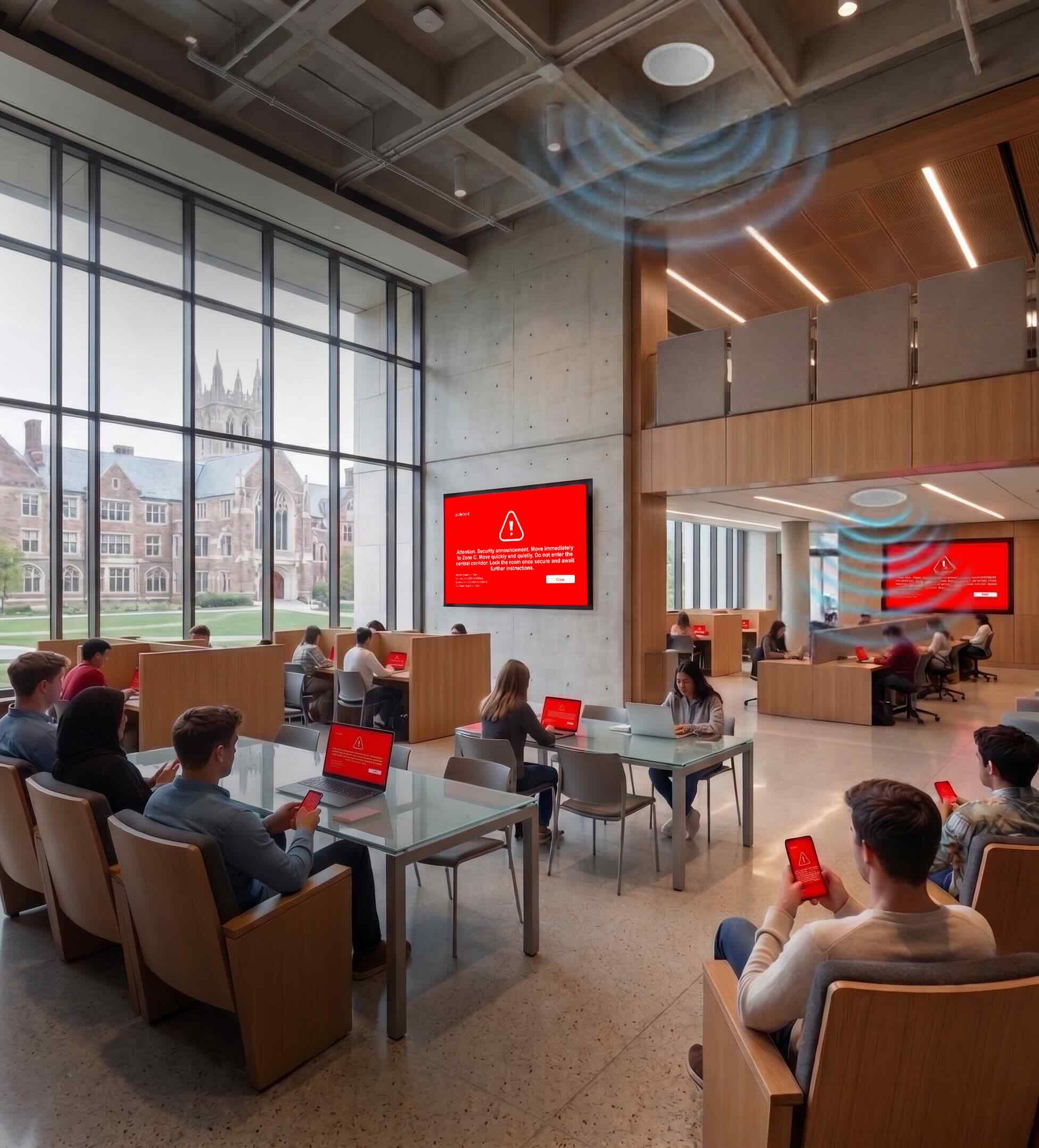
Understanding the four procedures and four measures is the starting point. The next step is putting them into practice, particularly communication, since evacuation, invacuation and lockdown all depend on staff and visitors being told clearly which one is happening.
Audiebant’s systems are designed to work alongside the infrastructure organisations already have in place, integrating as a plug and play addition rather than requiring existing equipment to be replaced. Our control portal brings this together across audio, visual and mobile channels, supporting the communication procedure with one consistent way to reach staff and visitors, however they need to be reached.
The full animations, along with the Terrorism (Protection of Premises) Act 2025: Statutory Guidance and other supporting resources, are available on the ProtectUK Martyn’s Law resources page.