In the last few weeks, the UK has seen a concentrated surge in malicious communications. From a packed arena in Birmingham to a local high school in Kirkham, these incidents are designed to spread fear and test the resilience of our public spaces.
While police investigations often find ‘no credible threat’ the damage is already done. The cost isn’t just financial; it’s the slow damage to public confidence and the psychological toll of those caught in the middle.
A week of disruption across the UK
This hasn’t just been happening in one area, it’s been everywhere. Looking at the last few days, we can see how much trouble these fake threats cause:
- Utilita Arena, Birmingham: On May 1st, a reported ‘suspicious bag’ led to the emergency evacuation of 13,000 people during a Peter Kay show. The comedian was moved to safety mid-performance while venue security and West Midlands Police cleared the building. The huge operation was a major test of the venue’s crowd control and safety procedures.
- St George’s Shopping Centre, Preston: Just a few days ago, a hoax call triggered a full-scale security response at this city centre hub. The centre had to be cleared, and a police cordon put in place while a thorough search was carried out. In a large retail space, the challenge is making sure every person on site gets the same safety instructions at the same time.
- Stafford College, Staffordshire: On May 6th, the courts heard the case of a student who had made specific threats to blow up the college. While the threat was prevented, the case highlighted the vital role of ‘safeguarding’ and ‘early warning’. It proved that for colleges, having a plan to deal with a sudden security alert is no longer optional, it is a necessity.
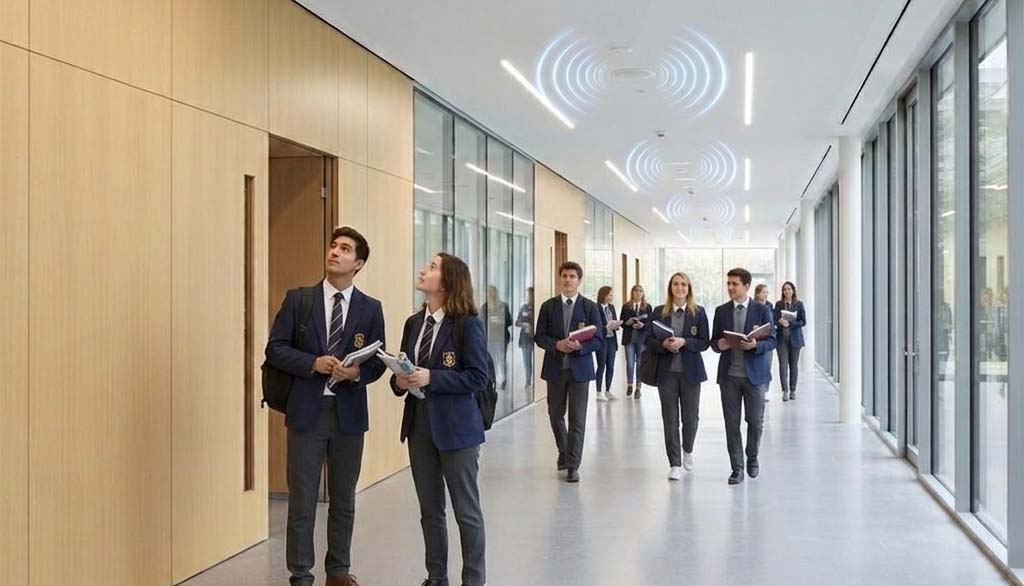
- Carr Hill High School, Kirkham: On 8th May, the school was forced to trigger its security protocols following a threat. In a school environment, the priority is a “controlled response” making sure students are moved to safe areas without the confusion that can lead to a secondary safety risk.
- Kirklees College, West Yorkshire: On 9th May, the site went into lockdown after receiving malicious emails. Students were kept inside classrooms while West Yorkshire Police investigated. Officers confirmed the messages were a hoax at around 12pm and a 20 year old man was subsequently arrested in Huddersfield on suspicion of malicious communications. As an Audiebant customer, Kirklees College was able to communicate clearly and quickly with staff and students throughout, keeping everyone informed and calm while the situation was assessed. Read their recent case study here.
The problem with the ‘generic siren’
In many buildings, the only way to alert people is a standard siren or fire bell. While this tells everyone there is a problem, it isn’t specific. It doesn’t tell people where they need to go or what they need to do. This creates two major safety risks:
- Confusion over what to do: A siren is usually associated with a fire, which tells people to head outside to an assembly point. During a bomb threat, the safest protocol is often the opposite: staying inside and moving away from windows. If the alarm isn’t specific, people might walk straight into a dangerous area while trying to evacuate.
- A lack of direction: A siren doesn’t give real instructions. This leaves people standing in hallways or congregating in large groups while they try to figure out what is happening. In a security situation, that uncertainty is dangerous.
How clear communication protects the public
Each of these incidents tells the same story: the threat itself was manageable, but the response depended entirely on how quickly and clearly people could be told what to do. To manage a security threat effectively, you have to control the information.
In every case, the difference between a controlled response and dangerous confusion comes down to one thing: communication. That’s why mass communication systems are now a core part of a building’s safety infrastructure, not a nice-to-have, but the thing that makes every other safety plan actually work.
The rise in hoax threats across the UK proves that generic alarms are no longer enough to manage modern risks. The goal in every one of these situations is the same, stay in control, keep people calm, and clear the way for emergency services to do their job. Clear, direct communication is what makes that possible. For schools, shopping centres and arenas alike, it’s no longer a question of whether you need a mass communication plan. It’s a question of whether yours is ready.