Orginally published on: National Preparedness Commission
Written by: Dr G. Keith Still BSc PhD FIMA FICPEM SFIIRSM FIPM FHEA MAE
Martyn’s Law: Security and Sound
In 2027, Britain will implement the Terrorism (Protection of Premises) Act1, known as Martyn’s Law. This legislation, born from tragedy, will require venues hosting more than 200 people to take concrete steps against terrorist attacks.
Much of the debate around Martyn’s Law has focused on physical security: bag checks, perimeter control, staff training. Yet the Act’s most consequential impact may lie elsewhere. It will force a rethinking not only of how venues prevent attacks, but how they communicate when prevention fails.
From Fire Drills to Terror Response
Historically, venues have relied on public address systems covering only main public spaces. Backstage areas, offices, and toilets often remain in acoustic isolation. Under Martyn’s Law, such gaps become more than technical oversights. They become operational vulnerabilities.
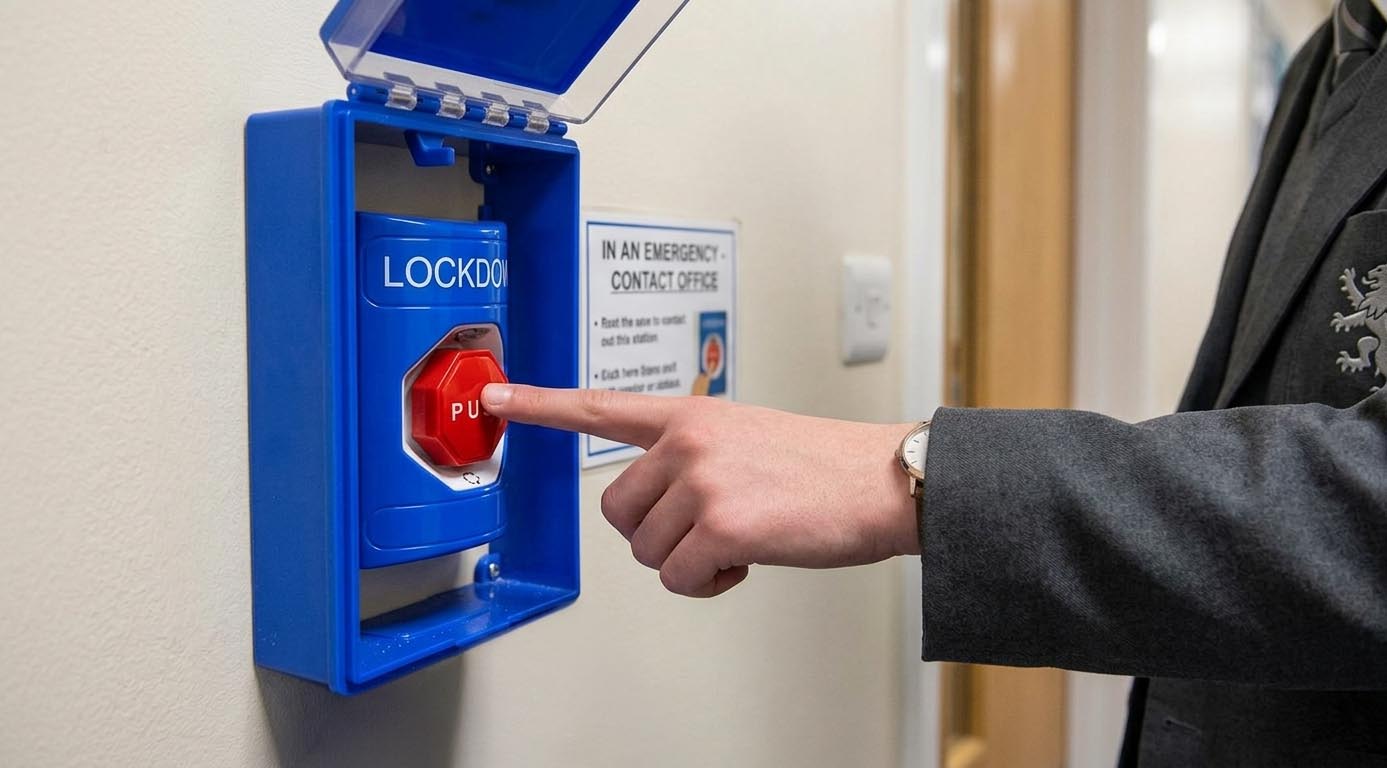
Experience from fire safety has already demonstrated that a single integrated voice system is more effective than fragmented installations. But hostile threats introduce new complexities. Martyn’s Law introduces scenarios beyond simple evacuation: directing patrons away from suspect packages, lockdown procedures requiring people to hold position and close doors, and invacuation potentially requiring external loudspeakers in car parks and forecourts—areas many systems ignore entirely.
Effective response depends on clear, authoritative, and adaptable instruction. It requires the ability to direct people away from danger, to reassure those sheltering in place, and to update guidance as new information emerges.
Preparedness requires that everyone — audience, staff, contractors — can hear and understand instructions wherever they are.
The Campus Conundrum
The Act applies to qualifying premises individually. But risk does not respect architectural boundaries.
Universities, hospital trusts, shopping centres and transport hubs operate as campuses rather than isolated buildings. A threat that begins in one structure may quickly affect another. A communication plan that stops at the doorway may satisfy regulation but fail reality.
Preparedness in such environments requires integrated, site-wide capability: centralised control, zoned messaging, and predefined escalation protocols across multiple buildings and external areas.
Car parks, queuing zones and forecourts — often excluded from legacy systems — are precisely where early confusion can take root.
The challenge is therefore not merely compliance, but coherence. This creates opportunities for intelligent systems integrating messaging, zoning, and control across large sites.
Lessons Learnt
The science of crisis behaviour has been settled for decades. Between 60% and 75% of evacuation time is consumed by people deciding whether to move, not moving.
Jonathan Sime’s 1989 research2 showed two-thirds of evacuation duration consisted of people waiting for clarity rather than heading for exits. After the 2017 Manchester Arena attack, unclear public messaging contributed to disorientation3. At London Bridge the same year, survivors reported the absence of early instruction created additional risk4.
By contrast, during the Stade de France attack in 20155, spectators were deliberately kept inside and managed through calm public address messaging. At Nathan Phillips Square in Toronto in 20196, rapid announcements prevented wider panic.
The lesson is simple and the conclusion is stark: people behave irrationally in the absence of information. Clarity saves minutes, and minutes save lives.
A Regulatory Grey Zone
The absence of applicable standards complicates the technical landscape. Martyn’s Law is not a fire-safety regulation, so relying solely on fire-based standards for voice-alarm communication is insufficient. Installing certified voice-alarm systems everywhere may prove prohibitively expensive. Pragmatism is essential: hybrid systems combining voice-alarm for public zones with simpler addressable PA or networked audio elsewhere may offer the best balance.
Robust communication plans begin with mapping the venue and understanding every area where people may be. Scenario planning is essential, with predefined messages for evacuation, invacuation, lockdown, and all-clear messaging. This expertise now overlaps with intelligent mass communications systems: mapping spaces, working from CAD plans, and evaluating options in real time can now be solved using AI tools.
The Rise of Intelligent Communication
Technology has moved faster than regulation. Over recent years, integrated emergency communication platforms have emerged that unify audio announcements, screen overrides, mobile alerts and wearable triggers within a single interface.
These systems can broadcast multilingual messages, override digital signage, push alerts that bypass “do not disturb” settings, and provide silent escalation mechanisms for staff. Increasingly, they incorporate spatial modelling and AI-assisted scenario analysis to support faster decision-making
Used responsibly, such tools do not replace human judgement. They reduce cognitive load at the moment it is most strained.
The economics are shifting too. The cost of integrated systems is falling, while the reputational and legal costs of poor communication are rising. Compliance is becoming less about hardware expenditure and more about risk governance.
The Future of Emergency Mass Communication
Martyn’s Law does not require Britain’s venues to become fortresses. It requires them to become more deliberate about how they manage risk.
Physical security measures aim to prevent harm. Communication measures aim to limit it when prevention fails. The two are inseparable.
Effective emergency messaging delivers tangible benefits beyond regulatory alignment: faster incident resolution, clearer command structures, reduced liability, and — crucially — public confidence. When police need to communicate different instructions to people indoors and outdoors, or when fire commanders require real-time intelligence from staff on the ground, these systems become force multipliers rather than obstacles.
Martyn’s Law offers an opportunity to shift from reactive noise to authoritative clarity. Preparedness is ultimately about choices made before the sirens sound. The next public inquiry should not have to ask why, when we knew how to communicate clearly, we chose not to.
References:
- The Terrorism (Protection of Premises) Act 2025. https://homeofficemedia.blog.gov.uk/2025/04/03/martyns-law-factsheet/
- Kimura, M. and Sime, J.D., 1989. Exit Choice Behaviour During the Evacuation of Two Lecture Theatres. Fire Safety Science 2: 541-550. doi:10.3801/IAFSS.FSS.2-541
- Manchester Arena Inquiry, 2022. Volume 2: The Emergency Response. Available at: https://www.gov.uk/government/collections/manchester-arena-inquiry-reports
- Intelligence and Security Committee of Parliament, 2018. The 2017 Attacks: What needs to change? HC 1694. Available at: https://isc.independent.gov.uk/wp-content/uploads/2021/01/20181122_HC1694_The2017Attacks_WhatNeedsToChange_Accessible.pdf
- Pepperdine University School of Public Policy, 2016. The Attacks on Paris: Lessons Learned. Available at: https://publicpolicy.pepperdine.edu/hsac/content/hsac-paris-lessons-learned_whitepaper.pdf
- CBC News, 2019. 4 people shot during Raptors rally at Nathan Phillips Square. 18 June. Available at: https://www.cbc.ca/news/canada/toronto/raptors-rally-shooting-1.5178886